
Staff Report
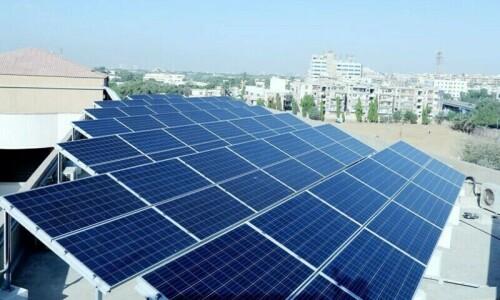
ISLAMABAD: In a major policy shift aimed at curbing the rapid expansion of solar net metering, the government has reduced the buyback rate by one-third to Rs10 per unit and scrapped net billing, making solar energy significantly less attractive for consumers.
The decision, which applies to new net-metering consumers, was taken during a meeting of the Economic Coordination Committee (ECC) of the Cabinet, chaired by Finance Minister Muhammad Aurangzeb on Thursday.
Under the new policy, power companies will purchase surplus solar electricity at Rs10 per unit during the day, while selling grid electricity at Rs42 per unit (off-peak) and Rs48 per unit (peak) after sunset—excluding additional taxes and duties. Moreover, consumers can no longer install solar systems exceeding their sanctioned load, with only a 10% margin allowed, down from the previous 50% limit.
Existing consumers will gradually be shifted to this new framework once their seven-year contracts expire.
Rationale Behind the Policy Shift
The Power Division justified the move, claiming that current net-metering consumers were adding a nine-paisa per unit impact on electricity prices, translating to an annual cost of Rs101 billion. Officials warned that if left unchecked, this burden could soar to Rs545 billion (Rs3.6 per unit) by 2034.
However, the policy faced criticism from key ministers. Petroleum Minister Ali Pervez Malik said the decision would send a negative signal to the market and consumers and could have been handled more effectively.
Power Minister Awais Leghari defended the move, arguing that urban middle-class consumers were benefiting disproportionately from low-cost self-generated electricity while avoiding capacity charges and transmission costs.
An official pointed out that salaried and urban consumers—who already bear heavy taxes and rely on costly, inefficient grid electricity—will now be forced to sell surplus solar power at Rs10 per unit while buying it back at Rs65-70 per unit during peak hours. This, the official said, would push many to invest in expensive battery storage or move entirely off-grid.
Lack of Consultation Sparks Concerns
The Power Division made the decision without consulting key stakeholders, including the power regulator (Nepra), the Federal Board of Revenue, and the Ministry of Finance. The summary was only circulated to Nepra, the Ministry of Industries, and the National Energy Efficiency and Conservation Authority (Neeca), but their feedback was not considered due to the urgency of the matter.
The ECC authorized the Power Division to direct Nepra to revise the buyback rate and adjust it periodically in the future. The new settlement mechanism will separate imported and exported units—with exported units purchased at Rs10 per unit while imported units will be billed at peak/off-peak rates.
Additionally, if the value of exported units exceeds the imported bill, the excess will be credited to the next billing cycle, but consumers will not be allowed to encash those credits.
Regulatory Adjustments and Solar Expansion
Nepra will now cap the hosting capacity of each distribution transformer and feeder and set inverter standards that enable real-time grid interaction through Wi-Fi, GSM, and other communication interfaces.
Officials noted that falling solar panel prices have fueled a sharp increase in net-metering consumers. By December 2024, net-metering consumers had shifted a burden of Rs159 billion onto grid users, a figure projected to reach Rs4.24 trillion by 2034 without intervention.
The number of solar net-metering consumers surged to 283,000 by December 2024, up from 226,440 in October 2024, highlighting the accelerating shift towards solar energy.
Other ECC Approvals
The ECC also approved a summary from the Ministry of Maritime Affairs, allowing Agven Private Ltd, operating in the Gwadar North Free Zone, to export up to 10,000 tonnes of potassium sulphate fertiliser annually until December 31, 2025. The decision aims to support the Gwadar Free Zone while ensuring regulatory oversight through biannual shipment limits and data monitoring.
Additionally, the ECC approved five supplementary grants worth Rs1.2 billion, including:
Rs250 million for the Ministry of Federal Education,
Rs220 million for the Ministry of Industries to support small and medium enterprises (SMEs),
Rs36.1 million for the Ministry of Interior for Sindh Rangers’ helicopter maintenance,
Rs15 million for Frontier Corps Balochistan’s helicopter maintenance,
Rs670 million for Sustainable Development Goals (SDG) initiatives in Islamabad.