Monitoring Desk
In a landmark move, the Supreme Court of Pakistan on Monday live-streamed its constitutional bench proceedings for the first time as it resumed hearing review petitions against its July 12, 2024 verdict that had declared the PTI eligible for reserved seats in the National Assembly.
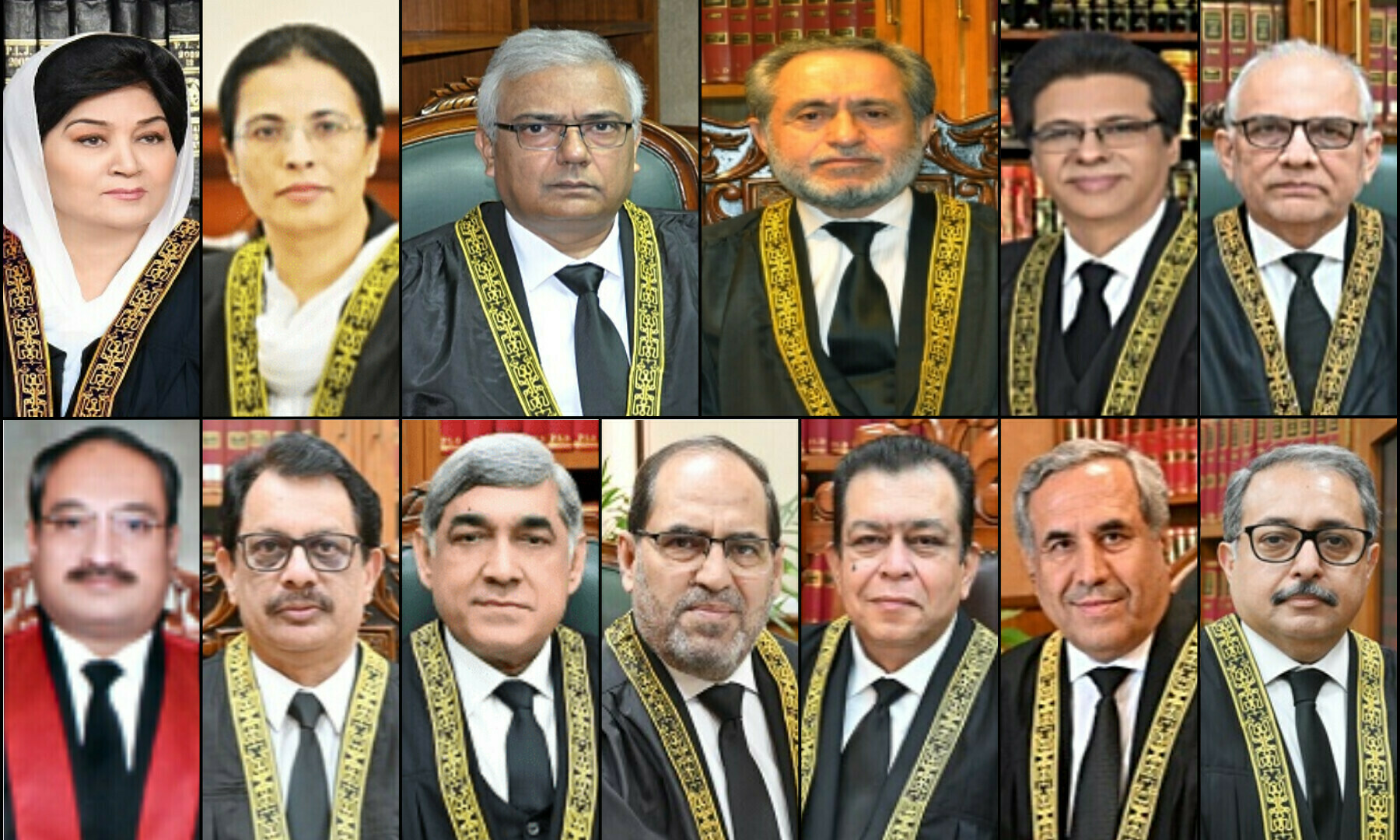
An 11-member constitutional bench (CB), led by Justice Aminuddin Khan, took up the petitions filed by the PML-N, PPP, and the Election Commission of Pakistan (ECP), challenging the earlier ruling which recognized 39 out of 80 MNAs as PTI candidates—potentially making the party the single largest in the lower house.
The court proceedings were streamed live via the Supreme Court’s official YouTube channel, marking a first in the institution’s history.
Backdrop and Political Stakes
The July verdict had not yet been implemented by the National Assembly, and the ECP had also raised objections. The petitions under review relate to a power struggle over reserved seats, particularly those transferred to the Sunni Ittehad Council (SIC) after independent candidates backed by PTI joined its ranks post-election.
The court previously convened a 13-member bench on May 6. However, Justices Ayesha A. Malik and Aqeel Ahmed Abbasi declared the review pleas inadmissible and withdrew from further proceedings. Justice Ayesha later raised concerns with Chief Justice Yahya Afridi over her dissenting note not being uploaded to the SC website.
In her dissent, Justice Ayesha criticized the ECP’s failure to implement the court’s July 12 order, warning it could undermine both the authority of the judiciary and democratic values.
Arguments in Court
During Monday’s hearing, senior lawyer Makhdoom Ali Khan presented arguments on behalf of PML-N and PPP women candidates affected by the July verdict. He contended that the denotification of lawmakers was done without prior notice, in violation of procedural fairness.
Justices questioned the eligibility of SIC to claim reserved seats. Justice Musarrat Hilali asked how independents could join a party that had not contested elections. Makhdoom confirmed that SIC had not participated in polls and its chairman, Sahibzada Hamid Raza, contested as an independent.
Justice Jamal Khan Mandokhail remarked, “The Sunni Ittehad Council could have become a parliamentary party, but it does not have the right to reserved seats.”
Justice Muhammad Ali Mazhar pointed out that the Supreme Court had already struck down the ECP’s notifications denotifying PTI-linked lawmakers, emphasizing the legal finality of the court’s orders.
Makhdoom also referenced Article 255 of the Constitution, arguing that election matters should be challenged only via election petitions. However, the bench observed that reserved seats fall under proportional representation, not regular election contests.
Reserved Seats Tug-of-War
In its detailed verdict, authored by Justice Mansoor Ali Shah, the Supreme Court previously found that the ECP’s conduct had harmed the PTI and violated its obligations as an impartial electoral body.
Following that decision, the government introduced the Elections (Second Amendment) Act, 2024, seeking to bar independents from joining parties after a specific window. This legislation is widely seen as an attempt to undermine the court’s ruling in the reserved seats case.
Meanwhile, PTI’s petition against the amendment, as well as another challenging the loss of its election symbol, remain pending before the Supreme Court.
Next Steps
The hearing was adjourned till Tuesday (tomorrow) after the counsel concluded his arguments and written responses were submitted by PML-N and the ECP.
As legal battles over representation and legitimacy continue, today’s hearing — televised in real time for the first time ever — signals a new era of judicial transparency while setting the stage for one of the most consequential rulings in Pakistan’s evolving political crisis.