
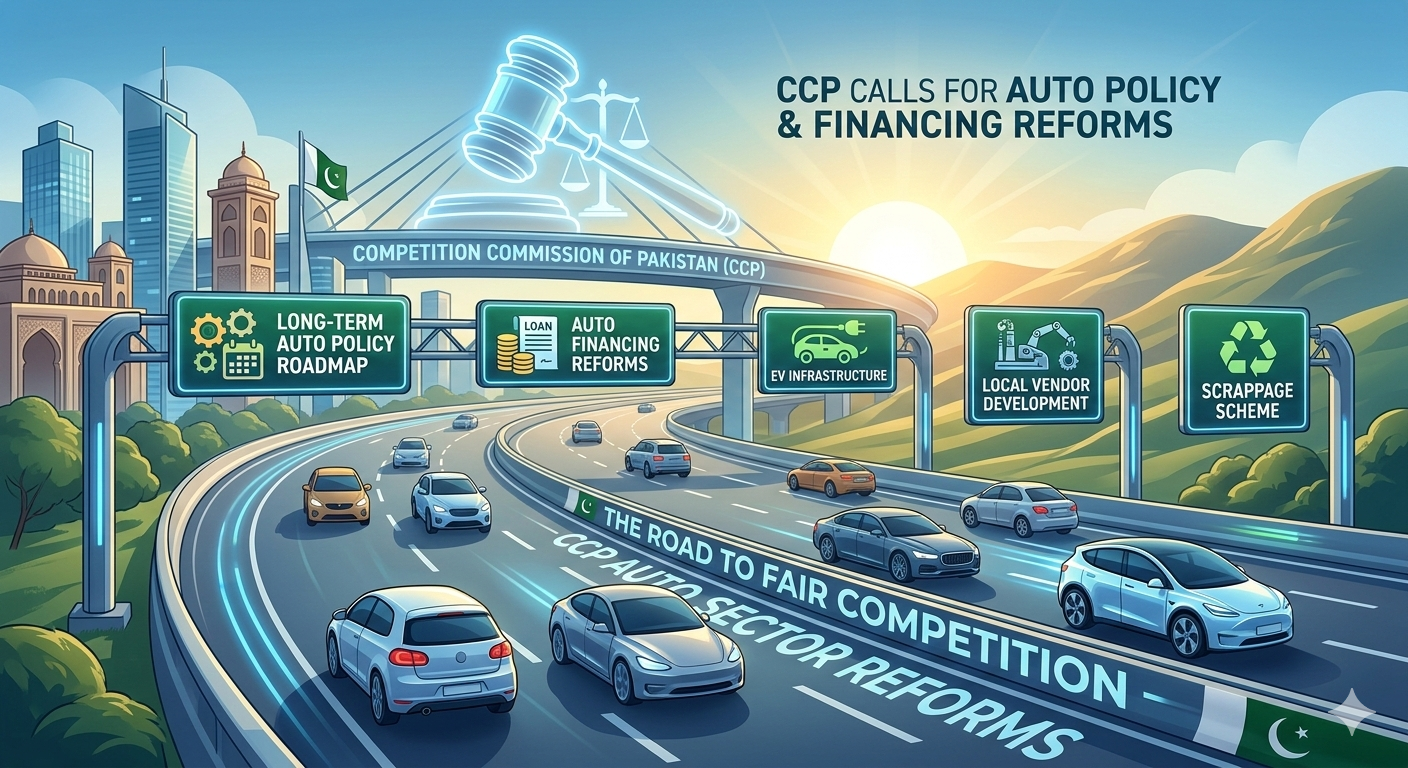
No significant improvement in competitive pricing or market diversity has been observed, as structural barriers continue to restrict automobile industry competition in Pakistan, according to a study released by the Competition Commission of Pakistan (CCP).
The report, “The Road to Fair Competition – A Study of Pakistan’s Automobile Industry,” highlights persistent market concentration in passenger car segments despite multiple policy interventions aimed at promoting competition and industrial expansion.
The study observes that high capital requirements, regulatory complexity, and protection-oriented tariff structures have limited new market entrants. Although earlier auto policies sought to enhance localization and encourage exports, implementation gaps and policy inconsistencies weakened their effectiveness.
The CCP emphasized that sustained protection measures have not consistently translated into improved efficiency or global competitiveness. Instead, the market structure remains relatively fragmented in regulatory governance but concentrated among established manufacturers.
To improve affordability and market access, the Commission recommended expanding vehicle financing opportunities by reviewing existing auto loan restrictions and introducing targeted financing support for first-time buyers in coordination with financial authorities.
Regarding electric vehicles, the study called for a predictable transition framework, noting that inadequate charging infrastructure, limited domestic manufacturing capacity, and reliance on fossil fuel-based electricity remain major challenges for EV adoption.
The report also stressed the need for a comprehensive vehicle scrappage policy to gradually phase out older, high-emission vehicles. Such a scheme could enhance road safety, support environmental sustainability, and stimulate demand for newer vehicles.
For industrial development, the CCP recommended transparent localization policies and stronger vendor ecosystem development to integrate Pakistan’s auto industry into global supply chains.
The Commission urged policymakers to rationalize distortive protections gradually, eliminate regulatory asymmetries, and adopt stable, pro-competition frameworks to encourage innovation and investment.
CCP officials said that a more competitive automobile sector could deliver long-term benefits to consumers, including improved vehicle quality, wider product choice, and potentially lower prices. The study is available on the CCP website for public feedback.