
Monitoring Desk
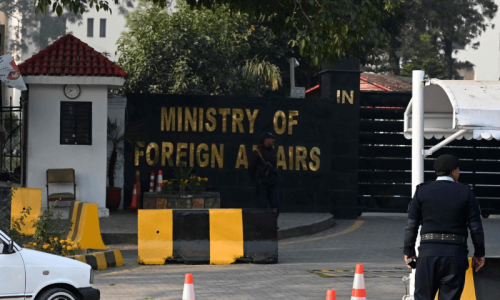
ISLAMABAD: Pakistan on Tuesday reaffirmed its commitment to the ongoing ceasefire understanding with India but warned that any future act of aggression would be met with full resolve.
The statement from the Foreign Office came in response to a provocative speech by Indian Prime Minister Narendra Modi on May 12, which Pakistan condemned as inflammatory and misleading.
In its official response, the Foreign Office rejected what it termed “provocative and inflammatory assertions” by the Indian premier, calling his remarks “a dangerous escalation rooted in misinformation, political opportunism, and a blatant disregard for international law.”
During his speech, Modi accused Pakistan of launching retaliatory strikes on Indian military and civilian targets and claimed that India’s air defence systems had successfully repelled the attacks, causing “significant losses” to Pakistan. He further asserted that Pakistan requested a ceasefire on May 10 through military channels following a failed retaliation — a narrative Pakistan strongly disputed.
Calling India’s portrayal “yet another blatant lie,” Pakistan clarified that the ceasefire was achieved “through the facilitation of several friendly countries” and labelled the Indian version “misinformation and propaganda.”
Following the truce, both countries began working out operational details. According to diplomatic sources, the first post-ceasefire contact between the Directors General of Military Operations (DGMOs) led to an agreement to uphold the truce and reduce troop deployments along the international border. Another round of DGMO-level talks is expected soon.
The FO also stated that the recent “Pahalgam incident” was used as a pretext by India to justify military adventurism and serve domestic political interests. “India recklessly escalated the situation further by targeting Pakistan’s military bases, risking an uncontrollable spiral of conflict,” the statement added, warning that such actions brought the region to the brink of disaster.
Pakistan further condemned India’s justification of civilian casualties, accusing New Delhi of normalizing violence. “Cold-blooded murder of innocent civilians cannot be accepted as the ‘new normal’ in the region,” the FO said.
In response to Indian accusations of terrorism sponsorship, Pakistan reiterated that it is itself a victim of terrorism, “directly sponsored by India.” The FO also highlighted Islamabad’s global contributions and sacrifices in the fight against terrorism.
Touching on the Indus Waters Treaty, the FO condemned India’s unilateral stance and warned that Pakistan would take all necessary measures to preserve its rights under the historic agreement. This followed Modi’s speech in which he said, “Terror and talks cannot go together… Water and blood cannot flow together.”
Modi also announced a new Indian policy that rules out dialogue with Pakistan outside the framework of terrorism and the issue of Azad Kashmir. Responding to this, the FO said: “Peace is the true strength. The world is not served by theatrical militarism and grandstanding but by mature leadership and respect for international norms.”
The FO reaffirmed Pakistan’s support for a peaceful resolution of the Kashmir dispute as per UN Security Council resolutions and emphasized that its commitment to peace must not be mistaken for weakness.
In a related development, security forces in Lahore shot down an Indian drone near the city’s airport using GPS jamming technology. Law enforcement officials identified it as an “Indian surveillance drone” launched in the wake of the ceasefire agreement.
The Indian Ministry of External Affairs also responded to the FO’s statement, defending its actions and claiming that the destroyed “terrorist infrastructure sites” were responsible for civilian deaths in India and globally. “There is now a new normal. The sooner Pakistan gets used to it, the better,” the statement read.