Monitoring Desk
ISLAMABAD: Prime Minister Shehbaz Sharif on Tuesday extended a compelling invitation to global investors to explore Pakistan’s vast mineral resources, offering business-friendly policies, joint technology ventures, and research collaboration — all underpinned by assurances of strong security from the Pakistan Army.
Addressing the Pakistan Minerals Investment Forum 2025 at the Jinnah Convention Centre, Islamabad, the premier highlighted the immense untapped wealth across the country—from Balochistan’s rugged terrain to the valleys of Sindh and Punjab’s plains, to the snow-capped mountains of KP and Gilgit-Baltistan.
He said, “If we are able to harvest these great assets, Pakistan can say goodbye to IMF programmes,” stressing the importance of channeling investments into value-added industries rather than exporting raw materials. “Going forward, downstream processing of minerals for local value addition will be a key policy for all international partnerships,” he declared.
Prime Minister Shehbaz welcomed companies from Europe, the US, China, Saudi Arabia, Turkiye, the UAE, and others, encouraging them to invest not only in minerals but also in training centres to equip Pakistani youth with modern, entrepreneurial skills. He particularly lauded Mark Bristow, CEO of Barrick Gold, for driving progress on the long-stalled Reko Diq project.
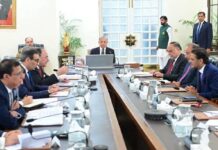
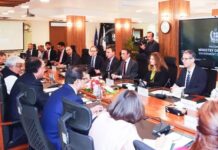
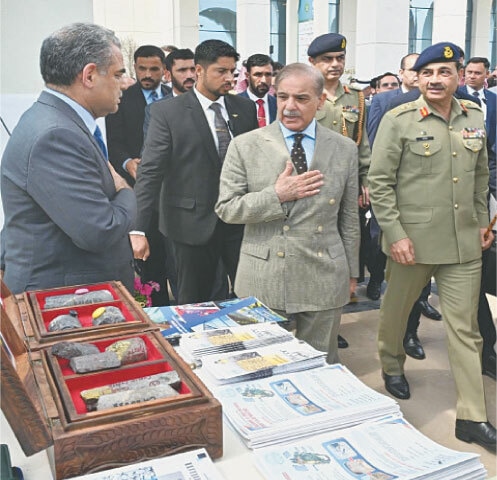
More than 300 participants, including chief ministers, governors, diplomats, global CEOs, and military leadership, gathered under the Special Investment Facilitation Council (SIFC) banner to promote Pakistan’s minerals sector as a key economic driver.
Chief of Army Staff (COAS) General Asim Munir, while addressing the forum, assured international investors that Pakistan’s security apparatus stands fully prepared to protect their interests—especially in Balochistan, a province rich in resources but troubled by unrest.
“Economic security is now a vital pillar of national security,” said Gen Munir, adding that a robust security framework would be in place for all investors and partners. “With vast reserves beneath our soil, skills in our hands, and a transparent mineral policy, there is no room for despair or inaction.”
Gen Munir also announced that 27 students from Balochistan are currently undergoing mineral exploration training in Zambia and Argentina, as part of Pakistan’s efforts to develop human capital for the mining sector.
He emphasized the need to focus not just on exploration, but also on refining and value addition, which would help reduce costs and open diversified global markets for Pakistan.
Deputy Prime Minister and Foreign Minister Ishaq Dar, in his opening remarks, said Pakistan was strategically located within the Tethyan Metallogenic Belt, home to one of the world’s largest copper-gold deposits. He noted that Pakistan was aligning its regulatory frameworks with competitive fiscal terms, positioning the country as a future global mining hub.
Dar highlighted Fitch and Moody’s recent credit rating upgrades as indicators of Pakistan’s improving economic outlook and commitment to fiscal discipline.
“This forum is anchored in three pillars — potential, people, and policy — a vision that will drive shared prosperity and sustainable growth,” Dar concluded.
With political resolve, military assurance, and international interest converging at the forum, Pakistan aims to transform its minerals sector into a pillar of economic revival and long-term national development.